Website brief for an agency: what to include, with a template
How to write a website brief for an agency: the goals, scope, content, integrations, budget and decision details agencies need, a copy-ready template, and fixes for the brief problems that derail projects.
A good website brief tells an agency why you need a new site, what it has to do, and how the project will run. Get those three right and the proposals you receive are much easier to compare.
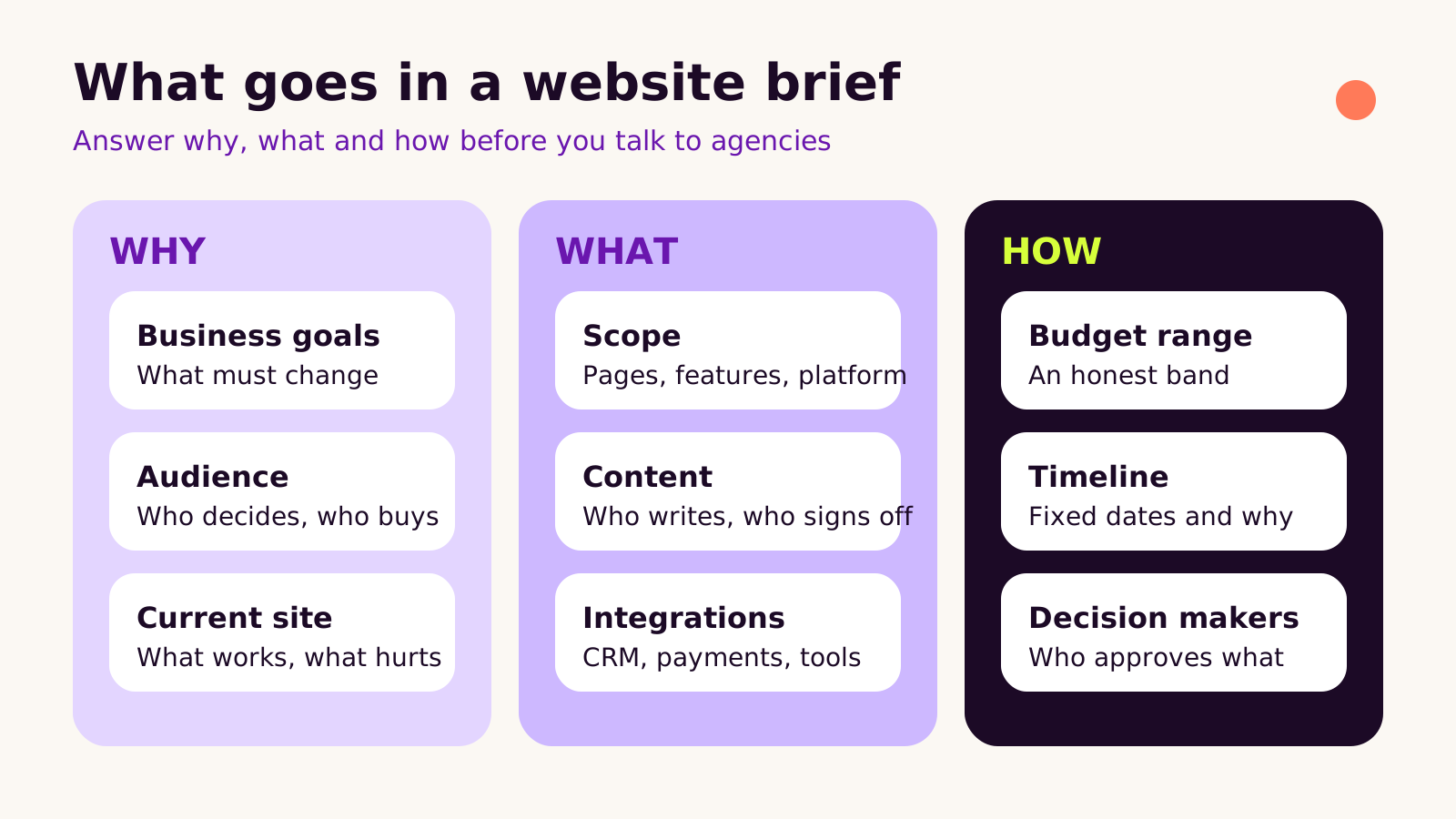
Start with the why: the business goal, who the site is for, and what is wrong with the current one. Then the what: the scope, the platform if you already have a preference, who writes the content, and which tools the site must connect to, such as your CRM or payment provider. Finally the how: an honest budget range, any fixed dates and the reason behind them, and who signs off on decisions.
Keep it short and plain. Show examples of sites you like and say why. Don't write a feature wish list without priorities, and don't hide the budget.
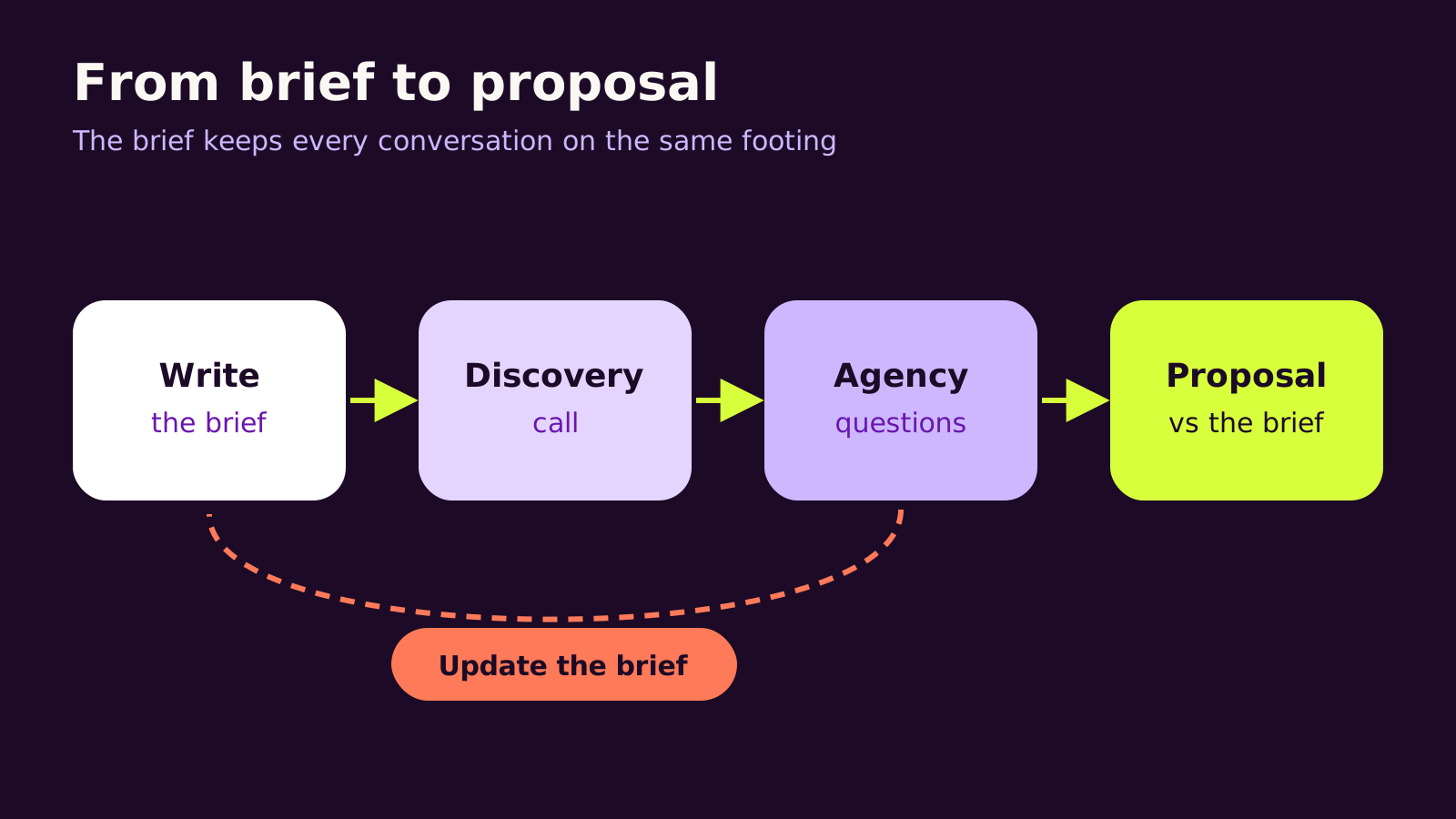
Use a short brief when you are talking to one or two agencies, and a fuller request for proposal when you want to compare several. Either way, treat the brief as a living document and update it after the first conversations. Then judge each proposal against it.
If you're about to hire an agency for a new website or a redesign, the most useful thing you can do first is write a website brief. This guide is for founders, marketing leads and operations managers who need to explain a project to an agency clearly. You'll learn what a website brief should include, how it differs from a formal request for proposal, and you'll get a template you can copy and fill in today.
The problem most buyers describe is simple: they send the same short email to three agencies and get back three proposals that can't be compared. One quotes for a theme tweak, one for a custom build, one for a full rebrand. None of them is wrong. They just guessed differently, because the brief left too much to guess.
Why a vague website brief costs you time
An agency turns your brief into a scope, a plan and a price. Every gap in the brief becomes an assumption, and every assumption either inflates the quote (the agency protects itself) or shrinks it (the agency wants to win), then reappears later as a change request.
The usual gaps are predictable:
- No goal. "We need a modern website" doesn't tell anyone whether success means more demo requests, fewer support emails or a store that handles a bigger catalogue.
- No content owner. Copy, photography and product data are often the slowest part of a project, and nobody said who produces them.
- Hidden integrations. The CRM, the ERP, the booking tool or the payment provider surface in week three, not in the brief.
- No budget signal. Without one, agencies can't tell whether you want the lean version or the ambitious one.
How agencies actually read a brief
It helps to know what happens on the other side. When we read a brief at the studio, we're trying to answer three questions before anything else: why does this project exist, what exactly has to be built, and how will the project run. Everything else in the brief is supporting detail for one of those.
The why sets priorities
Goals and audience decide what gets attention when time or budget runs short. A B2B site that exists to book sales calls is designed around case studies, pricing clarity and a short form. A store that exists to sell repeat purchases is designed around search, reorders and fast mobile checkout. Same budget, very different sites.
The what sets the size
Scope, content and integrations drive most of the effort. A list of page types (home, service, product, article, landing page) is more useful to an agency than a page count, because templates are what get designed and built. Integrations matter because each one has its own data, accounts and testing.
The how sets the shape
Budget, timeline and decision makers decide how the work is phased. A fixed launch date tied to a trade show or a product release might mean launching a smaller first version and adding the rest after.
How to write a website brief, step by step
Aim for a document someone can read in one sitting. Plain language beats polish. Work through these steps in order:
- 1 Write one paragraph on the business goal. What should the site make easier, and how will you know it's working? Describe it in your own terms: more qualified enquiries, fewer "where is my order" emails, editors who can publish without a developer.
- 2 Describe the audience and the decision they make. Who visits, what they need to see before acting, and what they do next.
- 3 Say what works and what hurts on the current site. Be specific: "the team can't add a landing page without us" or "the checkout breaks on some phones". Include links.
- 4 List page types and features, with priorities. Mark each one must-have, should-have or later. This is the single most useful thing you can do for a fair quote.
- 5 Name the platform, or say you're open. If you're on Shopify or WordPress and happy, say so. If you're unsure, say that too and ask for a recommendation. Our guide to choosing between Webflow and WordPress for a B2B website shows the kind of trade-offs involved.
- 6 Say who owns content. Who writes copy, who supplies images, who translates, and who approves.
- 7 List every system the site touches. CRM, email platform, payments, shipping, inventory, analytics, chat. Note which ones you're keeping.
- 8 Give a budget range and the dates that really matter. Explain why a date is fixed, so the agency can suggest a phased launch if needed.
- 9 Name the decision makers. One day-to-day contact, and who signs off on design, content and launch.
A copy-ready website brief template
Paste this into a document and replace each line with your answer. Leave a line blank rather than guessing; the agency can ask.
WEBSITE BRIEF

1. About us
   What we do, who we sell to, how we sell (online, sales team, both).

2. Goal of the project
   The problem we're solving and how we'll know it worked.

3. Audience
   Main visitor types, what each needs to see, the action we want next.

4. Current site
   URL, platform, what works, what doesn't, pages that must keep their URLs.

5. Scope
   Page types and features, each marked: must / should / later.
   Platform preference (or "open to recommendation").
   Languages, currencies, accessibility needs.

6. Content
   Who writes copy, supplies images, translates, approves.

7. Integrations
   CRM, email, payments, shipping, inventory, analytics, other tools.

8. Look and feel
   Brand guidelines (attached / none), sites we like and why, sites we don't.

9. Budget and timeline
   Budget range. Key dates and why they're fixed.

10. People
    Day-to-day contact. Who signs off design, content and launch.

11. After launch
    Who maintains the site, hosting preference, support we expect.
Brief or request for proposal?
| Website brief | Request for proposal | |
|---|---|---|
| Best when | You're talking to one or two agencies | You need to compare several formally |
| Length | Short, readable in one sitting | Longer, with specifications and a response format |
| Purpose | Start a useful conversation | Get comparable, structured bids |
| Extra sections | None needed | Selection criteria, response deadline, required pricing breakdown |
For most small and mid-sized projects, a good brief and a proper discovery call get you further than a long formal document. If procurement requires an RFP, start from the brief anyway and add the response format and selection criteria on top.
What we've learned from reading briefs
A few patterns come up again and again.
- Wish lists without priorities get padded quotes. If everything is a must-have, the agency prices everything. Ranking features is how you control cost.
- Hiding the budget rarely helps. We understand the instinct, but a range lets the agency propose the right version instead of a generic one.
- Solutions in the brief can box you in. "We need a mega menu" is fine, but tell us the problem too ("visitors can't find the right service"). There may be a simpler fix.
- Ownership belongs in the brief, not the contract stage. Say that the domain, hosting, code and analytics accounts must be in your name. Our guide to website ownership when you hire an agency lists exactly which accounts to keep.
- Redesigns need a URL list. If the site already ranks, list the pages that bring traffic. A migration such as moving from WooCommerce to Shopify depends on redirect planning from day one.
When wouldn't we push for a full brief? For a small, well-defined job (a new landing page on an existing site, a single integration), a few clear paragraphs and a call are enough.
Troubleshooting common brief problems
- Symptom: proposals are wildly different in scope. Likely cause: features weren't prioritised, or the platform was left open without saying so. Fix: send every agency the same must / should / later list and ask them to price must-haves separately.
- Symptom: the agency keeps asking the same questions. Likely cause: the goal or audience section is thin. Fix: add a paragraph on what visitors need to decide and what you want them to do next.
- Symptom: the timeline slips during content entry. Likely cause: nobody owned copy and images. Fix: name a content owner and agree content deadlines in the plan, or add copywriting to the agency's scope.
- Symptom: a surprise integration appears mid-project. Likely cause: the systems list came from marketing only. Fix: check with sales, finance and operations before sending the brief.
Questions people ask
How long should a website brief be?
Short enough to read in one sitting. If it's growing long, move detailed specifications into an appendix and keep the main brief focused on goals, scope, content, budget and people.
Should I include my budget in a website brief?
Yes, as a range. It lets the agency recommend the right approach for what you can spend, and it makes proposals easier to compare. You can still negotiate.
Do I need to choose a platform before writing the brief?
No. If you have a strong reason for a platform, say so. If not, describe your needs and ask the agency to recommend one and explain why.
Why a clear brief pays off for the business
A clear website brief shortens the sales stage, makes quotes comparable, and protects the project from the slow drift of unplanned changes. It also gives you a yardstick: when a proposal comes in, you can check it line by line against what you asked for. That's how you pick an agency on substance rather than on presentation.
Before you send yours, run through this checklist:
- The goal is written in business terms.
- Features are marked must, should or later.
- Content owners and approvers are named.
- Every connected system is listed.
- There's a budget range and the reason for any fixed date.
- Account ownership is stated.
If you'd like a second pair of eyes on your brief, or want to talk through a project with our website design and development team, get in touch.
(over to you)
Planning a build like this?
Tell us what you're building and we'll come back with ideas and next steps.
Keep reading
All articles Platform guides
· 4 min read
Webflow vs WordPress for a B2B website: how to choose
Read article
 Platform guides
· 7 min read
Website ownership when you hire an agency: what you should own
Read article
 Platform guides
· 6 min read
Google November 2026 core update: what to check and what to do
Read article